

MDM Bet India APK Access, Account Structure & Entry Logic
MDM Bet India APK functions as an alternative Android access layer built for users who want a more direct platform entry point than the browser version. It should be understood as a delivery format rather than a separate product environment. The same account structure, wallet logic, gameplay access rules, and verification states remain in place regardless of whether the user enters through browser or APK.
The APK does not create a second operational framework. A user logs in with the same credentials, uses the same account balance, and remains subject to the same review and eligibility rules attached to the main platform profile. This matters because many users treat an APK as if it changes access privileges or account behaviour. It does not. The interface changes, but the account layer stays consistent.
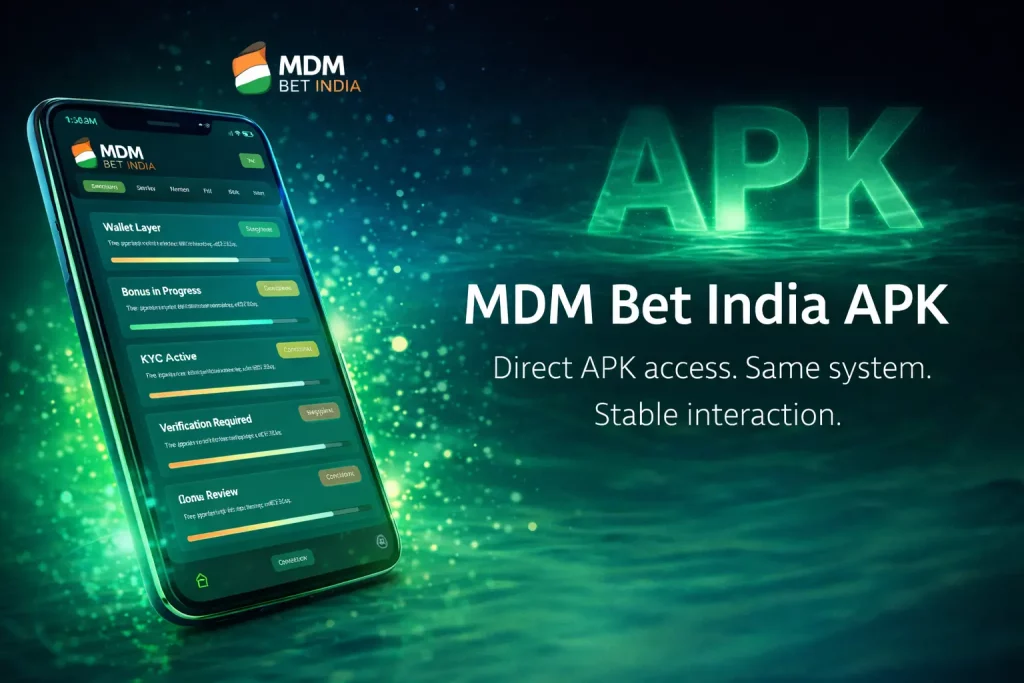
From a platform perspective, APK access is mainly about continuity and convenience. It can reduce dependency on repeated browser loading, improve reopen behaviour on Android devices, and provide a more stable access shell for users who regularly interact through mobile. This can make the experience feel more direct, but it does not alter any core gameplay logic or wallet-state logic.
Account visibility also remains structured inside the same system model. If an account is fully active, the APK reflects that active state. If a bonus is attached, the APK reflects the same conditional rule layer already attached to the account. If verification is required, that review status remains visible because it belongs to the account framework, not to the browser or app itself.
In practical terms, the APK should be seen as a mobile container for the same platform logic. It can improve access flow, but it does not change how deposits are handled, how withdrawals are reviewed, how bonus conditions are applied, or how system restrictions appear when an account enters a compliance-related state.
Account States, Wallet Logic & Access Controls
Installation Flow, Device Compatibility & Security Boundaries
MDM Bet India APK follows a manual installation flow that differs from standard app store distribution. The user downloads the APK file, enables installation permissions for external sources, and completes the setup directly on the device. This process does not alter the platform itself, but it changes how access is initiated and who controls the installation layer.
Because the APK is installed outside of managed app ecosystems, responsibility for source validation shifts to the user. The platform environment remains stable, but the integrity of the installation depends on where the file is obtained. Installing from the official platform source preserves alignment with the intended system structure. Installing from mirrors or third-party repositories may introduce modified packages, altered interface behaviour, or broken update paths.
Device compatibility is determined by Android version, available memory, background process handling, and general system condition. On newer devices, the APK typically provides smoother reopen behaviour, faster navigation, and less reliance on browser reload cycles. On older or resource-constrained devices, the application may still function but with reduced responsiveness or delayed transitions. These differences affect interface delivery, not gameplay outcomes or account logic.
Permissions granted during installation define how the application interacts with the device. The APK does not extend beyond these permissions. It does not access unrelated system areas, and it does not create hidden processes outside the defined application scope. However, users should still review permission prompts carefully, especially when installing or updating.
Updates are also part of the installation lifecycle. Unlike app stores, where updates are automated, APK updates may require manual action. Using outdated versions can lead to interface inconsistencies, slower loading behaviour, or partial incompatibility with current platform structure. Regular updates from the official source help maintain alignment between the access layer and the platform environment.
The key point is separation. Installation method affects access delivery, not system behaviour. RNG remains independent, RTP remains long-term, and wallet logic remains unchanged regardless of device, version, or installation path.
System Logic in APK Environment (RNG, RTP, Volatility, Wallet Layer)
MDM Bet India APK does not introduce a separate gameplay model. All core systems remain identical to the browser version. The application is only a delivery interface, while the outcome engine operates independently and consistently across all access formats.
RNG (Random Number Generator) continues to function as a memoryless system. Each outcome is generated independently of previous results, session duration, or user behaviour. The APK does not introduce adaptive behaviour, compensation cycles, or probability shifts. There is no internal mechanism that reacts to losses, wins, or betting patterns.
RTP represents a long-term statistical model embedded within game design. It does not describe short-term outcomes or session-level behaviour. Users may experience variation over shorter periods, and this variation is not corrected or adjusted by the system. The APK does not influence how RTP is realised; it simply delivers access to the same underlying model.
Volatility defines how outcomes are distributed across time. Some games generate frequent lower-value results, while others generate less frequent higher-value outcomes. This is a structural property of the game, not a performance indicator. The APK does not modify volatility or shift the distribution pattern.
The wallet system operates as a neutral tracking layer. It records balances, bonus states, and transaction flow, but it does not interact with gameplay probability. When a bonus is active, funds move into a conditional state defined by wagering requirements. This is a rule-based layer, not a progression system. Completion of wagering allows funds to transition into a withdrawable state, but does not influence outcomes during play.
Demo mode remains available as a way to explore game mechanics. It allows users to understand pacing, features, and interaction structure, but it does not replicate real-money conditions and should not be treated as predictive.
The separation between interface (APK) and outcome engine (game logic) is strict. The interface delivers access and interaction, while the outcome engine generates results independently of user identity, device type, or session context.
Platform Systems Overview
Updates, Performance, Wallet States & Cross-Device Use
MDM Bet India APK operates within the same account and system framework regardless of device or access format. Updates, performance conditions, and device-specific behaviour affect only how the platform is delivered, not how it functions internally. This distinction matters because users often associate performance changes with system changes, while in practice they are separate layers.
Updates are primarily technical. They improve compatibility with newer Android versions, adjust interface rendering, and stabilise session handling. They do not modify gameplay logic, RTP behaviour, or wagering rules. Using the latest APK version ensures alignment with the current platform structure and reduces the chance of interface inconsistencies or broken navigation paths.
Performance depends on device condition. Storage availability, RAM usage, background processes, and network quality all contribute to how smoothly the APK runs. Lower-end devices or overloaded systems may experience slower loading or delayed transitions. These effects belong to the interface layer and do not influence outcomes, balance tracking, or bonus behaviour.
Wallet states remain fully consistent across APK and browser access. If a user activates a bonus, the same conditional layer applies regardless of device. If verification is required, the same review status appears across all formats. If wagering is in progress, the same tracking logic continues without interruption when switching devices.
Cross-device usage does not reset or adjust system behaviour. Users can move between APK and browser environments without changing account structure, financial flow, or system restrictions. The platform treats all access formats as equal entry points into the same environment.
Security should also be maintained over time. Keeping the APK updated and avoiding unofficial sources helps preserve the integrity of the access layer. This ensures that the interface remains aligned with the platform while the underlying system continues to operate independently and consistently.
A useful addition here is that APK stability should be supported by clear version and source information inside the mobile environment. MDM Bet India can reduce confusion by showing the current APK version, update status, official source reminder, and compatibility notice in a visible account or settings area. This helps users understand whether a problem comes from an outdated build, weak device resources, network instability, or an account-level condition such as verification or bonus review.
This transparency also keeps technical performance separate from gameplay expectations. Faster loading, smoother reopening, cleaner wallet display, or improved Android compatibility can make the APK more comfortable to use, but they do not change RNG, RTP, volatility, wagering rules, or withdrawal logic. The APK remains an access layer, while account states, wallet rules, and game outcomes continue to operate through the same platform systems used across browser and mobile sessions.






Comments