

MDM Bet Bonus System as a Structured Account Layer
The bonus system inside MDM Bet should be understood as an account-level structure rather than a gameplay advantage. Bonuses do not modify how games behave, and they do not alter the probability model behind outcomes. Instead, they exist as a separate layer that interacts with the wallet and defines how certain funds can be used within the platform.
This distinction is important because many users interpret bonuses as something that increases their chances of winning. In a properly framed operator environment, that assumption is avoided. A bonus changes the rules attached to specific funds, not the mathematics of the games themselves. RTP remains a long-term statistical model. RNG remains independent and memoryless. Volatility remains a description of outcome distribution. None of these elements are influenced by whether a bonus is active or not.
What the bonus system actually does is introduce conditional access to funds. These conditions may include wagering requirements, time limits, eligible game categories, or maximum conversion rules. When a user activates a welcome bonus, a sign up bonus, or one of the available bonus offers, they are not receiving “better odds.” They are entering a structured rule environment where specific usage conditions apply.
From a product perspective, this makes bonuses part of the wallet logic rather than part of the game engine. The system tracks which funds are real balance, which are bonus funds, and how each type of balance can be used. This separation allows the platform to remain mathematically consistent while still offering structured incentives at the account level.
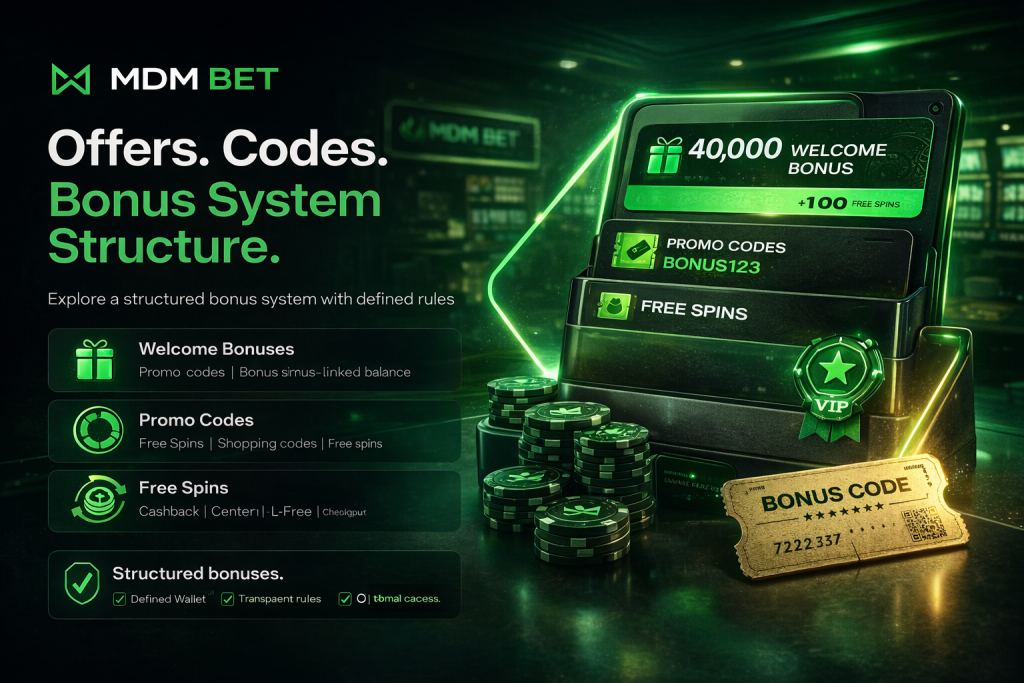
In the context of MDM Bet, the bonus system includes multiple entry points. A welcome bonus or sign up bonus may define the initial interaction with the platform. Free chips or free spins may provide limited exposure to specific game mechanics. Cashback bonus structures may return a portion of losses under defined conditions. Promo codes and bonus codes introduce optional activation paths. VIP program layers extend this structure for returning users. Each of these elements belongs to the same system, even though they appear in different forms.
Bonus Activation Is a Rule Decision, Not a Default State
Bonuses should not be treated as something that automatically improves the account. In many cases, they are optional. Activating a bonus means accepting a set of rules. Not activating it means continuing with a standard wallet structure. This choice is important, especially for users who prefer full flexibility over their balance without additional conditions.
For example, no deposit bonus codes and bonus code for existing players often provide access to bonus funds without requiring an upfront deposit. However, these funds typically come with stricter wagering requirements or tighter usage conditions. Similarly, bonus funds tied to a welcome offer may require a defined amount of eligible staking before they can be converted into withdrawable balance. These are not hidden mechanics. They are part of the structure.
Understanding this helps position bonuses correctly. They are not shortcuts. They are structured paths. A user entering that path should be aware of the conditions attached to it. That clarity improves both user experience and long-term trust in the platform.
Overview of Available Bonus Types in MDM Bet
The following table organizes the main bonus categories available within the MDM Bet environment. It focuses on how each type functions at a system level rather than presenting them as promotional highlights.
| Bonus Type | Function | Typical Condition | Usage Model |
|---|---|---|---|
| Welcome Bonus / Sign Up Bonus | Initial deposit-based bonus structure for new users | Wagering required before withdrawal | Extended balance usage |
| No Deposit Bonus / Free Chips | Provides limited funds without upfront deposit | Higher wagering constraints | Restricted exploratory use |
| Free Spins | Allows predefined number of slot rounds | Winnings subject to conversion rules | Game-specific interaction |
| Cashback Bonus | Returns part of net losses under conditions | Time-based or activity-based eligibility | Loss-offset mechanism |
| Promo Codes / Coupons | Manual activation of specific bonus offers | Requires correct code entry | Optional activation path |
| VIP Program | Tier-based reward structure for active users | Based on activity and retention | Long-term engagement layer |
Bonus Mechanics: Wagering, Conversion, and Time Windows
Once a bonus is activated, the platform applies a structured rule layer to the associated funds. This is where the mechanics become more important than the label of the bonus itself. Whether it is a welcome offer, bonus funds, cashback bonus, or free spins, the system defines how those funds behave before they can be converted into withdrawable balance.
The central element in this structure is wagering. Wagering is not a task or a progression system. It is a measurement of eligible staking volume. When a bonus carries a wagering requirement, it means that a defined amount of bets must be placed using eligible games before the bonus funds can be released. This does not guarantee any outcome. It simply defines how much activity must occur within the rules of the system.
Another important factor is eligibility. Not all games contribute equally toward wagering. Some may contribute fully, others partially, and some not at all. This again reinforces the idea that bonuses operate in a rule environment rather than a performance environment. The system is tracking how funds are used, not how successful those bets are.
Time limits also play a role. Many bonus offers, including promo codes and coupons, are bound to specific validity windows. If the wagering condition is not completed within that timeframe, the remaining bonus funds may expire. This is not a penalty mechanism. It is part of the defined structure of the offer.
Free spins follow a similar logic but with a narrower scope. They are usually tied to specific games and generate winnings that may then enter a wagering phase. Cashback bonus structures operate differently, typically calculating a return based on net loss over a defined period, but they still exist within the same rule-based system.
The key point across all these mechanics is consistency. The rules are predefined and do not adapt based on session behaviour, login frequency, or account status. RNG remains independent. RTP remains long-term. Volatility remains unchanged. The bonus layer sits on top of these systems without modifying them.
Structural View of Bonus Mechanics
The chart below illustrates how different components of the bonus system relate to each other in terms of structural weight. This is not a profitability chart and should not be interpreted as a measure of gain or outcome. It is a model of how the rule layer is constructed inside the platform.
Bonus Systems Remain Independent from Game Logic
Even when all these mechanics are active, the core behaviour of games remains unchanged. This is the most important boundary to maintain. Bonus systems define how funds are handled. They do not define how results are generated. A slot spin remains an independent RNG event. A roulette outcome remains bound to fixed probability distribution. A blackjack round remains decision-based within a defined rule set.
Understanding this separation helps avoid incorrect expectations. Completing wagering does not increase future success. Activating a bonus does not improve outcomes. Using promo codes does not change volatility. The system is consistent because these layers do not overlap.
For the user, this clarity simplifies decision-making. The choice is not about “better odds.” It is about whether the structure of the bonus fits the intended use of the account. That is a cleaner, more accurate way to evaluate any bonus environment.
Segmented Bonus Types and User Context
Not every bonus is designed for the same user situation, and that is one of the reasons bonus systems should be explained by structure rather than by headline. A no deposit bonus code serves a very different role from a VIP program. Free chips and free spins usually sit closer to low-commitment exploration. A welcome offer or sign up bonus is generally tied to account entry and first funding behaviour. Cashback bonus structures are more often linked to retention or post-activity balance logic. Promo codes, bonus code fields, and coupons act as optional activation routes layered on top of the main offer system.
This segmentation helps users read the platform more accurately. Instead of seeing a long list of promotions as a collection of interchangeable benefits, they can understand that each one is attached to a different account context. Some are meant for first access. Some are designed for continued participation. Some are tied to manual activation. Some simply adjust how a certain wallet state is treated for a limited time. The value in the page comes from making those distinctions visible without turning the content into a hard-sell catalogue.
On an operator-level platform, this also improves trust because it removes the illusion that all bonus types are universally useful. They are not. A user who prefers immediate balance flexibility may find a bonus with heavy wagering less suitable than standard cash play. A user exploring the platform for the first time may see value in free spins or a sign up bonus because those structures lower the barrier to initial interaction. A returning user may respond more to cashback bonus logic or a bonus code for existing players. The correct framing is not “which one is best,” but “which one fits the account situation and usage pattern.”
New Account Bonuses and Early Platform Entry
The first segment usually includes welcome bonus, welcome offer, sign up bonus, and in some cases no deposit bonus codes. These are entry-level account structures. Their function is not simply to “give more,” but to shape the early wallet state and define the user’s first interaction with the bonus layer. They often come with the most visible promotional language, but underneath that language the mechanics remain the same: activation conditions, eligible games, wagering, expiry, and conversion rules.
A welcome bonus is typically the clearest expression of this system because it sits directly at the intersection of onboarding and wallet logic. The user deposits, the bonus is triggered or claimed, and a rule layer is applied. A sign up bonus works similarly, though it may be tied more narrowly to first registration or first funding. No deposit bonus codes move away from deposit dependency, but they usually become stricter in other areas, especially conversion and wagering structure. That is why these offers should not be described as “free value” without context. They are conditional account states.
Ongoing, Returning, and Manual-Activation Bonus Paths
The second major segment includes bonus code, bonus code for existing players, promo codes, promotions, coupons, cashback bonus, and VIP program logic. These structures are usually more contextual. They are less about entering the platform and more about how the platform continues to organize account engagement over time.
Promo codes and coupons matter because they require an active decision from the user. They are not always applied automatically. That means the account state changes only if the correct trigger is used. This is useful from a product perspective because it allows more selective distribution of offers without forcing them into every wallet state. Bonus code for existing players serves a similar role but is more explicitly tied to returning or already active accounts.
Cashback bonus structures also differ from front-end offers because they often respond to net loss patterns inside a defined period. This does not mean they “repair” outcomes or improve future probability. It means that, under specific rules, part of the account loss may be returned to the wallet as a structured balance type. VIP program logic extends even further into long-term account segmentation. But again, the correct boundary remains important: VIP may change access to certain offers or service layers, yet it does not change RTP, alter RNG, or create better game outcomes.
Analytical View of Bonus Types by Account Context
The table below groups the main MDM Bet bonus categories by likely account context and operational purpose. This makes the system easier to read than a flat list of offer names.
| Bonus Group | Main Formats | Typical Account Context | Operational Reading |
|---|---|---|---|
| Entry Bonus Layer | Welcome bonus, sign up bonus, welcome offer, no deposit bonus codes | New registration or first funding stage | Onboarding-led |
| Exploration Layer | Free chips, free spins | Low-commitment exposure to platform mechanics | Restricted use |
| Manual Activation Layer | Promo codes, coupons, bonus code | User-triggered offer entry through explicit code or campaign path | Trigger-based |
| Retention Layer | Cashback bonus, promotions, bonus code for existing players | Returning user activity or defined post-play account state | Condition-led |
| Tiered Account Layer | VIP program, recurring bonus offers | Longer-term segmented account engagement | Tier-based |
Bonus Choice Should Follow Use Case, Not Hype
A clean bonus page helps the user evaluate fit rather than chase labels. That means explaining which offers are likely tied to onboarding, which ones require manual activation, which belong to longer-term retention, and which are best understood as exploratory tools with limited scope. This approach is more accurate than flattening every offer into the same promotional language.
For MDM Bet, that clarity is especially useful because the bonus list is broad. It includes first-access offers, low-entry formats, code-based triggers, retention tools, and tiered structures. Presenting these types by context makes the system more readable and supports a calmer product experience. Bonus logic becomes something the user can understand, not something the page tries to oversell.
Responsible Framing of Bonus Use
A well-structured bonus page should reduce interpretation, not amplify it. Bonuses are optional account states. Activating one introduces a defined rule layer; not activating one leaves the wallet in a standard state. This is a choice about structure, not about outcomes.
From an operator perspective, the most important boundary remains unchanged: bonus systems do not interact with the outcome engine. RNG continues to generate independent events. RTP remains a long-term statistical model. Volatility continues to describe distribution, not expected return. None of these elements are modified by a welcome bonus, cashback bonus, free spins, or any other offer format.
This matters because bonus perception often drifts toward expectation. Users may assume that completing wagering improves future results or that certain bonus types create better conditions. That is not how the system is built. Wagering is a release gate tied to eligible staking volume. It measures activity, not success. Conversion rules determine when funds become withdrawable, not whether outcomes become favourable.
VIP program logic also fits into this framework. It may change access to certain offers, support layers, or account segmentation, but it does not change game mathematics. VIP ≠ better outcomes. It is a different layer of account management, not a different probability environment.
Bonus Selection as a Structural Decision
Choosing whether to activate a bonus should be based on how the rule set aligns with intended usage. A user who prefers full flexibility may choose to avoid heavy wagering structures. A user exploring the platform may find value in free chips or free spins as a limited interaction layer. A returning user may consider cashback bonus structures depending on how those rules are defined.
This approach shifts the focus from “value” to “fit.” Instead of asking which bonus is the most attractive, the more relevant question is whether the conditions attached to it match how the account will be used. This leads to more predictable outcomes in terms of user experience, even though the game results themselves remain independent.
It also reduces friction later in the process. Many issues with bonuses arise not from the rules themselves, but from misunderstanding those rules at the point of activation. A clear page minimizes that gap by explaining structure upfront rather than relying on post-activation clarification.
Dashboard View of Bonus System Layers
The visual below presents the bonus system as a set of interacting layers inside the account environment. It does not represent performance, profitability, or outcome probability. It is a structural view of how different bonus-related elements connect to the wallet and rule system.
Bonus Systems Should Remain Predictable
A predictable bonus system is easier to use than a generous but unclear one. The user should know what happens when a bonus is activated, how long it lasts, what conditions apply, and how funds transition between states. When those elements are visible, the system feels controlled rather than uncertain.
For MDM Bet, the correct positioning remains consistent across the entire page. Bonuses are part of the account structure. They are optional. They introduce rules. They do not influence outcomes. That clarity keeps the product stable and avoids the need for exaggerated messaging.
A useful addition here is that predictability should be supported by visible bonus-state information inside the account. MDM Bet can make the system easier to understand by showing whether a bonus is inactive, active, expiring, restricted, wagering-linked, conversion-ready, or closed. This helps users read the wallet state correctly before they continue with any further account activity.
This structure also keeps bonus use aligned with responsible platform design. A bonus may change how funds are tracked, released, or restricted, but it does not change RNG independence, RTP structure, volatility, or the probability model inside any game. When these boundaries remain visible, users can treat bonuses as optional account tools rather than as signals of better outcomes or guaranteed value.






Comments