

Slots as a System Layer in MDM Bet
Within MDM Bet, slots do not function as isolated entertainment units. They operate as a structured product layer built on deterministic mathematical models and controlled randomness. The interface may suggest variety — themes, reels, bonus rounds — but underneath, every slot follows the same fundamental architecture: a random number generator, a payout model defined by RTP, and a volatility profile that shapes outcome distribution.
This matters because user perception often misaligns with system reality. A short session may feel “cold” or “hot,” but this is not a property of the slot adapting or reacting. The system does not track previous spins, does not compensate, and does not rebalance outcomes based on user behavior. Each spin is independent. The outcome is generated at the moment of interaction.
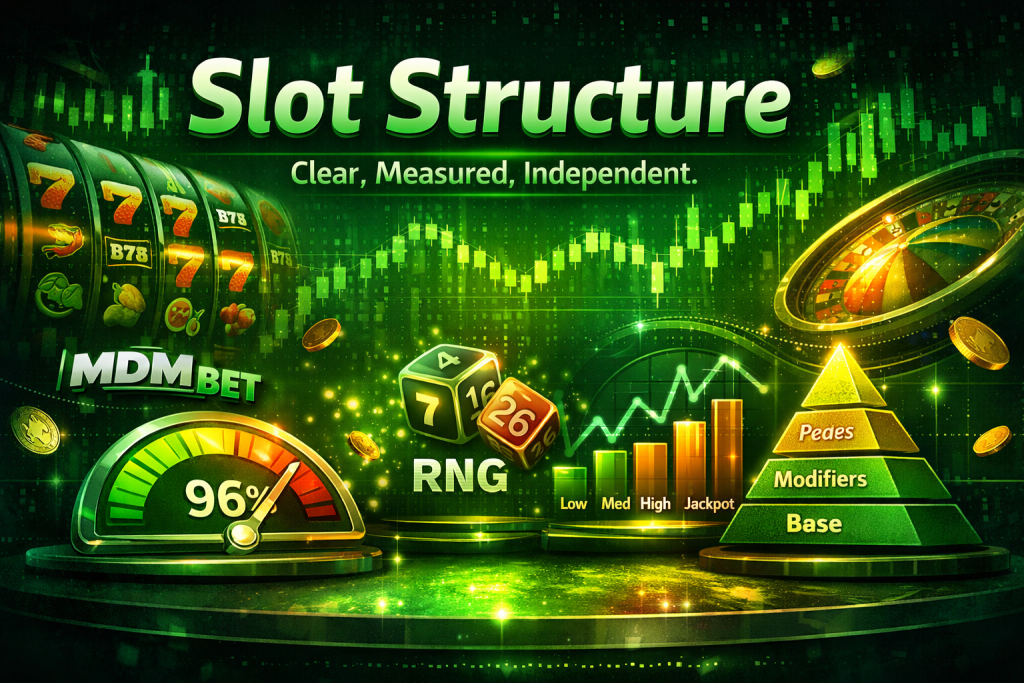
RNG operates as a memoryless mechanism. It produces sequences that are statistically aligned over large volumes, not within individual sessions. That distinction separates expectation from experience. A user may play ten spins or a hundred — neither carries statistical weight in terms of RTP realization.
RTP itself is not a promise. It is a long-term return model defined over millions of spins. When a slot shows 96% RTP, it does not mean a user will receive 96 back from 100 in a session. It means that across a large dataset of spins, the system is calibrated to return that percentage. The gap between theoretical RTP and short-term results is where volatility operates.
Volatility is often misunderstood as “risk level” or “profit potential.” In reality, it defines how outcomes are distributed. Low volatility spreads value across frequent smaller results. High volatility compresses value into less frequent, larger outcomes. Neither is better. They simply shape pacing and session rhythm.
In MDM Bet, this structure remains consistent across all slot titles — whether it is a classic fruit-style game or a modern multi-feature video slot. The presentation layer changes. The mathematical layer does not.
Slot Game Structure by Gameplay Model
| Slot Type | Core Mechanics | Volatility Pattern | Operational Reading |
|---|---|---|---|
| Classic Slots | 3 reels, fixed paylines, minimal features | Low to mid | Stable pacing |
| Video Slots | 5+ reels, bonus rounds, free spins | Mid | Feature-driven |
| Megaways | Dynamic reels, variable paylines | Mid to high | Variance spikes |
| Jackpot Slots | Pooled prize system across sessions | High | Low frequency events |
| Cluster Slots | Grid system, cascading wins | Mid | Chain-based outcomes |
The categorization above is not aesthetic. It reflects how value is distributed inside each system. A classic slot stabilizes expectation through frequency. A Megaways structure introduces variability through dynamic reel configurations. A jackpot system shifts probability mass toward rare events.
From a product perspective, these are not “better” or “worse” options. They are different models of interaction. The user is not choosing outcomes — only the structure through which outcomes are delivered.
Slot Mechanics and Outcome Distribution Layers
In MDM Bet, slot gameplay is not defined by visuals or feature labels. What matters is how the internal system distributes outcomes across different event layers. Each spin is a calculation, not a progression. The system does not move toward a result — it generates one independently every time.
A slot can be understood as a structure of probabilistic layers:
- Base Spin Layer — the default outcome cycle without modifiers
- Feature Trigger Layer — activation of bonus mechanics such as free spins or multipliers
- Expansion Layer — cascades, symbol expansions, chain reactions
- Peak Event Layer — low-frequency, high-impact outcomes
These layers are not sequential stages. They are conditional probabilities evaluated at the moment of each spin. A feature does not become “more likely” because it hasn’t happened recently. There is no accumulation, no balancing, and no recovery logic.
RNG remains independent and memoryless. Every spin resets the system state completely. This is the key distinction between perceived patterns and actual mechanics.
Volatility emerges from how these layers are weighted. A slot with higher concentration in the peak event layer will feel slower, with longer neutral sequences and occasional larger outcomes. A slot with more density in the base and feature layers will feel more active, but with smaller average values.
Event Density Across Slot Mechanics
anicsVolatility and Session Behavior in Slot Systems
Volatility is often reduced to a simple label — low, medium, high — but in product terms this classification is insufficient. What actually matters is how volatility shapes the session timeline: how long neutral sequences last, how often modifiers appear, and how concentrated meaningful events are within a given number of spins.
In MDM Bet, volatility should be read as a distribution model, not as a performance indicator. A high-volatility slot does not “pay more.” It compresses value into fewer, less frequent outcomes. A low-volatility slot distributes value across a larger number of smaller events. The RTP may be similar across both, but the experience is structurally different.
From a session perspective, three behavioral patterns emerge:
- Stable flow sessions — frequent small returns, limited spikes
- Interrupted flow sessions — longer neutral stretches with occasional feature entries
- Compressed sessions — extended inactivity followed by isolated high-impact events
These patterns are not modes the slot switches between. They are natural consequences of probability distribution. The user is not moving between states — they are observing different parts of the same distribution curve.
A key mistake is interpreting short-term sequences as signals. For example, a sequence of empty spins is often read as an indicator that a feature is “due.” This assumption does not hold. RNG does not track streaks. The probability of a feature trigger remains constant per spin.
The same applies to perceived “hot” periods. A cluster of wins does not increase or decrease future probability. It is simply a localized concentration within a larger random distribution.
From an operator perspective, the only reliable interpretation of volatility is structural:
how value is spaced across time, not whether a session is “good” or “bad.”
Slot Behavior by Volatility Model
| Volatility Type | Session Pattern | Event Frequency | Operational Reading |
|---|---|---|---|
| Low Volatility | Stable flow, frequent outcomes | High base hit rate | Consistent pacing |
| Medium Volatility | Balanced base and feature activity | Moderate trigger frequency | Mixed rhythm |
| High Volatility | Long gaps, occasional spikes | Low frequency, high impact | Compressed distribution |
| Extreme / Jackpot | Extended neutral periods | Very rare peak events | Event concentration |
Operational Reading of Slots in MDM Bet
Slots in MDM Bet should not be approached as systems that can be influenced, timed, or interpreted through short-term patterns. The product layer is fixed. RNG remains independent. RTP remains a long-term calibration. Volatility defines distribution — not outcome quality.
From an operator perspective, the only meaningful interaction available to the user is selection of structure, not control over results.
This changes how slots should be read.
A player does not choose when to enter a slot to “catch a cycle.” There is no cycle in the predictive sense. A player does not increase probability by extending a losing session. Probability does not accumulate. A player does not improve outcomes by switching between games rapidly or staying in one game longer. Each spin remains isolated.
What can be adjusted is exposure to different structures:
- Choosing a slot with higher base density leads to more frequent feedback, but lower event amplitude
- Choosing a slot with heavier feature layers leads to more conditional pacing
- Choosing a slot with compressed peak distribution leads to longer neutral sequences and occasional visible spikes
These are not strategies. They are structural preferences.
From a UX standpoint, MDM Bet presents slots as a catalog. From a product standpoint, it is a matrix of probability distributions.
Understanding this distinction removes false expectations:
there is no “optimal timing,” no “recovery phase,” no “due feature,” and no “session momentum” that changes the underlying math.
A useful addition here is that slot selection should be supported by clear structural labels inside the catalogue. MDM Bet can make the slot environment easier to understand by showing volatility type, RTP information, feature density, demo availability, minimum stake, and bonus eligibility separately on each game card or preview panel. This helps users compare games by mechanics and pacing rather than by visual intensity or promotional placement.
This separation also supports more controlled session behaviour. A user can choose a slot based on the type of experience they prefer — steadier base-spin rhythm, feature-heavy pacing, cascading event flow, or jackpot-style concentration — without assuming that any category creates better outcomes. RNG controls each spin independently, RTP describes long-term structure, and volatility shapes how results are distributed across time. The catalogue should make those boundaries visible before play begins.






Comments